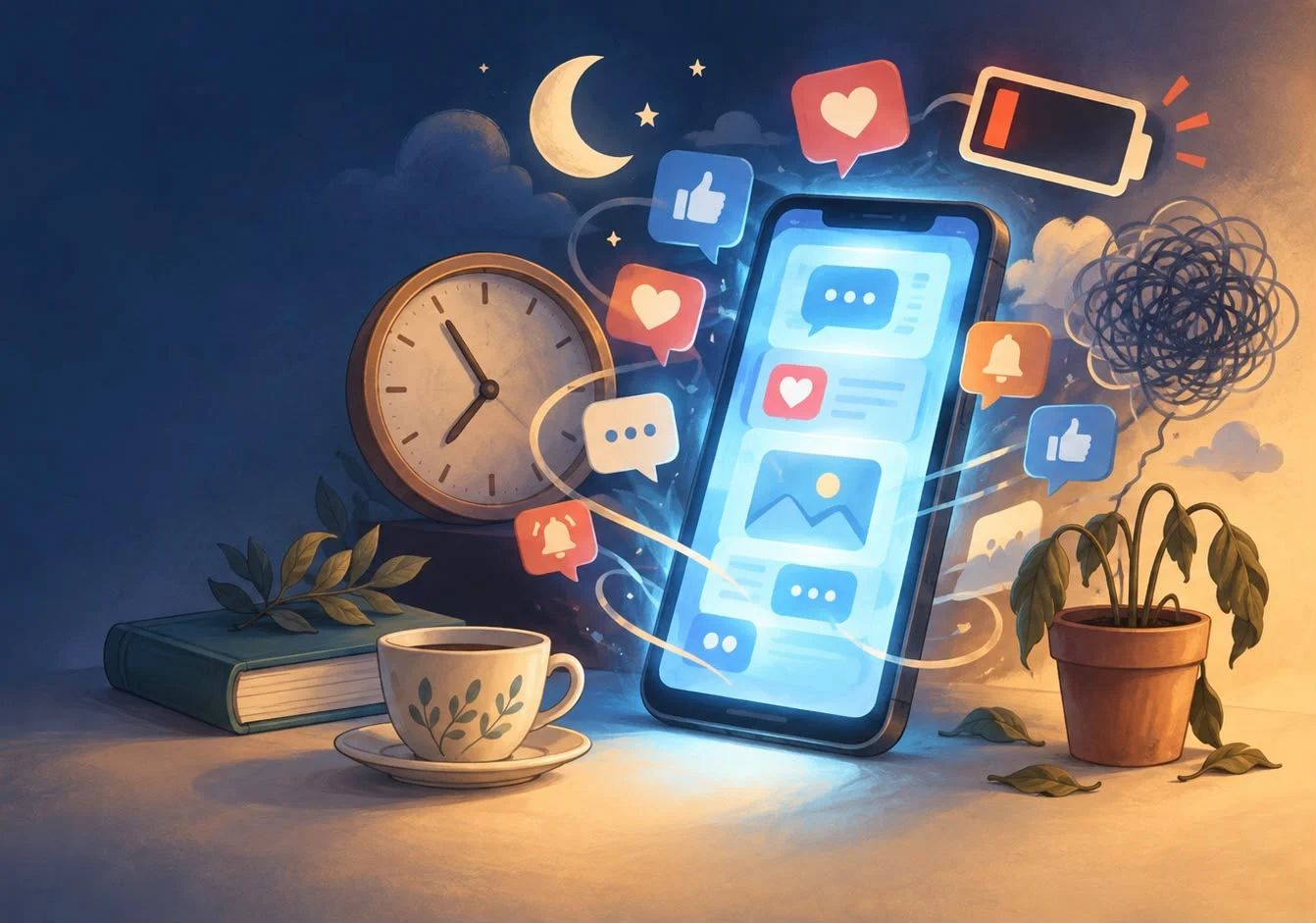
Mental health was a subject few people spoke about openly until a few years ago. Today, thankfully, there is greater awareness among young people, students and families, and the stigma is slowly reducing. People facing anxiety, depression or emotional distress are more likely to be heard with empathy. Yet, even as this conversation grows, one everyday habit with serious implications often escapes our attention: our increasing dependence on smartphones.
Look around any restaurant, bus stand, park, waiting room or office. We see people scrolling – often without purpose, and sometimes even while sitting with family or friends. The smartphone has become the first thing many of us reach for in the morning and the last thing we look at before sleeping. It is no longer merely a tool; for many, it has become a constant companion that is difficult to put down.
This dependence did not develop without reason. During the COVID-19 pandemic, work shifted home, students moved to online classes, and phones became essential for communication, information and entertainment. Those habits did not disappear when normal life resumed. A 2025 study published in Frontiers in Psychiatry, based on 322 university students, found that smartphone addiction was positively associated with negative emotions, while such emotions were linked with lower life satisfaction. The study also shows that the relationship can become a cycle: people may turn to their phones to escape stress or low moods, but excessive dependence can, in turn, worsen their emotional well-being.
Today, almost every part of daily life is routed through a screen. Beyond Facebook, Instagram, LinkedIn and X, we use Swiggy and Zomato to order food; Amazon, Flipkart and Myntra to shop; and numerous apps to book movies, hotels, flights, taxis and even medical appointments. This convenience is valuable. The problem begins when useful screen time quietly becomes compulsive screen time, and we lose control over when and why we pick up the phone.
The mental health effects can appear gradually. Constant notifications keep the mind in a state of alertness. Endless comparison with carefully curated lives on social media can create inadequacy and fear of missing out. Repeated switching between messages, reels and work reduces concentration and makes silence feel uncomfortable. Late-night use can disturb sleep, leaving us irritable, tired and less able to manage stress the next day. A 2025 review by Zhu and colleagues, available through the US National Institutes of Health’s PubMed Central database and published in Frontiers in Psychiatry, links excessive smartphone use with sleep disruption, loneliness, anxiety and depression, while also noting physical concerns such as eye strain and neck or upper-limb discomfort. Importantly, much of the evidence shows association rather than proving that phones alone cause every symptom; the relationship can work in both directions.
Children and young adults may be especially vulnerable because habits are being formed early. However, this is not only a youth problem. Parents checking messages during meals, professionals responding to work late at night, and older adults spending hours on videos are all part of the same picture. When every free moment is filled by a screen, we lose opportunities for reflection, conversation, movement, creativity and rest – all of which protect mental well-being.
The solution is not to reject technology, but to use it with intention. We can begin by checking our screen-time report honestly and identifying the apps that consume the most time. Non-essential notifications can be switched off, and phones can be kept away during meals, meetings and conversations. Creating phone-free spaces – particularly the bedroom – helps protect sleep. Setting fixed times for social media, taking short breaks, walking outdoors, reading a physical book or speaking to someone face-to-face can gradually rebuild healthier routines.
Joshua Becker, writing for Becoming Minimalist, recommends practical steps such as putting the phone away on arriving home, removing unnecessary apps and trying a regular phone-free day. These ideas are simple, but they restore an important principle: we should decide how technology fits into our lives, rather than allowing it to decide how we live.
We must also recognise when self-discipline is not enough. If phone use is repeatedly interfering with sleep, work, studies, relationships or mood, it may help to speak to a mental health professional. Asking for support is not a sign of weakness; it is an act of awareness.
Smartphones have connected the world, but connection through a device should not come at the cost of connection with ourselves and the people around us. The need of the hour is not a digital detox from life, but digital balance within life. Sometimes, the most meaningful thing we can do for our mental health is simply to put the phone down, look up and be fully present.
References
Zhu, W., Zhang, Y., Lan, Y., & Song, X. (2025). Smartphone dependence and its influence on physical and mental health. Frontiers in Psychiatry, 16, 1281841. Source
Zhu, C., Li, S., & Zhang, L. (2025). The impact of smartphone addiction on mental health and its relationship with life satisfaction in the post-COVID-19 era. Frontiers in Psychiatry, 16, 1542040. Source
Becker, J. 7 Proven Ways to Break Your Cell Phone Addiction. Becoming Minimalist. Source