
How small businesses can use artificial intelligence, automation and IoT to improve efficiency, reduce waste and make better business decisions.
Artificial Intelligence is perhaps one of the most talked-about subjects in business today. Almost every entrepreneur has heard of ChatGPT and other AI tools, and many already use them for emails, content, presentations or research.
But for an MSME entrepreneur, the more important question is not simply what AI can do. It is how artificial intelligence can solve a real business problem.
Can it save time? Reduce wastage? Improve customer service? Forecast demand? Prevent machine downtime?
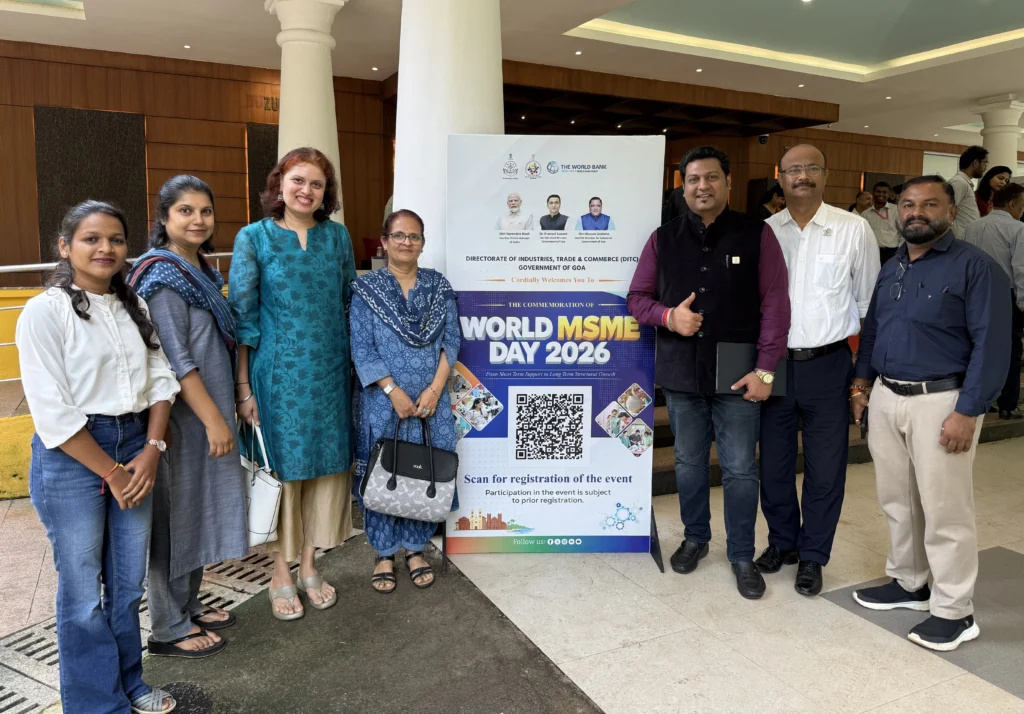
At a recent World MSME Day programme organised by the DITC – Directorate of Industries, Trade and Commerce, Goa, a technical session on “Future Proofing Your Enterprise – Integrating AI Technologies into Business Workflows” explored exactly this question.
The most relevant takeaway for small businesses was practical: AI adoption for MSMEs does not have to begin with expensive technology. It can begin with one business problem.
The MSME Technology Gap
MSMEs account for a significant share of businesses, employment and economic activity globally. Yet many small enterprises continue to operate through paper-based systems, scattered records and manual processes.
This creates a technology-adoption gap.
The question, therefore, is not whether MSMEs need digital transformation. It is how they can adopt technology simply, gradually and usefully.
For many businesses, the first step towards AI is not AI at all. It is digitising information and creating systems that allow the business to understand its own operations.
Three Technologies Driving MSME Transformation
Digital transformation for MSMEs can broadly be understood through three connected areas:
- Artificial Intelligence
AI can support businesses with:
Customer-service chatbots
Demand forecasting
Pricing analysis
Fraud detection
Personalised marketing
Data analysis
Content and communication support - Internet of Things (IoT)
IoT connects machines, devices and sensors to provide real-time information.
For MSMEs, this can enable:
Machine monitoring
Asset tracking
Smart inventory management
Energy monitoring
Quality control
Cold-chain monitoring - Intelligent Automation
Automation can reduce repetitive manual work in areas such as:
Invoice processing
Data entry
Reports
Order processing
Customer responses
Reminders and follow-ups
For an MSME, where manpower, time and cost are critical resources, the value lies in identifying which process
needs improvement first.
How Can MSMEs Use AI in Different Industries?
The use of AI is no longer limited to large corporations.
Manufacturing
Predictive maintenance can help identify potential machine failures before breakdowns occur. Sensors can monitor machine performance and energy consumption, while computer vision can assist with quality inspection.
Retail and Trade
AI-powered demand forecasting can help businesses understand buying patterns and reduce overstocking or stock-outs. Automation can also support routine customer communication and offers.
Logistics
Route optimisation and data analysis can help reduce fuel consumption and improve operational planning.
Agriculture and Food Processing
Sensors can monitor moisture, crop conditions and cold-chain temperatures. Automation can also assist with grading, sorting and reducing wastage.
Tourism and Hospitality
Chatbots and automated customer communication can improve response times, while data can help businesses better understand customer preferences.
The common thread across industries is simple: technology becomes valuable when it improves a measurable business outcome.
AI Adoption Does Not Have to Be Expensive
One of the biggest misconceptions among MSMEs is that artificial intelligence requires significant investment and sophisticated infrastructure.
That is changing.
Many AI and automation tools now offer affordable or free entry-level options.
Tools such as ChatGPT and Claude can assist with communication, research and analysis. Canva AI can support marketing activities. Cloud platforms can make business data accessible from different locations, while automation tools can reduce repetitive administrative work.
A live demonstration during the session showed how AI could generate a social-media post, draft a quotation email, create a seven-day marketing campaign and suggest solutions to an operational business problem within minutes.
The bigger barrier may no longer be cost alone.
It is awareness and the ability to identify where technology can genuinely help the business.
A Five-Stage AI Roadmap for MSMEs
For small businesses wondering where to begin, the journey does not have to be complicated.
- Digitise
Move away from scattered paper records and store important business information securely in digital systems or cloud platforms. - Assist
Use AI tools to support everyday activities such as emails, customer FAQs, marketing material, research and analysis. - Automate
Identify repetitive tasks such as invoices, reports, reminders, social-media scheduling or data entry and automate them where possible. - Analyse
Use dashboards and analytics to understand:
Sales
Cash flow
Inventory
Customer behaviour
Demand patterns - Scale Intelligently
Once the foundations are in place, AI and IoT can gradually be integrated into production, inventory, sales and supply-chain management.
Not every MSME has to reach the final stage tomorrow.
The important thing is to begin with the right problem.
People First, Technology Second
Technology adoption is not only about software.
One of the most important considerations for MSMEs is the people who will use it.
AI should automate repetitive work and free employees for higher-value activities such as customer engagement, problem-solving and innovation.
Businesses can begin by identifying one or two employees comfortable with technology and encouraging them to become internal AI champions. Over time, they can help others understand and adopt new tools.
Technology should support people and the enterprise — not become an end in itself.
How Should an MSME Start Using AI?
Perhaps the most practical advice is also the simplest:
Start small.
Choose one repetitive process in your organisation.
Try automating it.
Then measure the result.
Did it:
Save time?
Reduce cost?
Reduce wastage?
Improve customer service?
Improve decision-making?
If the answer is yes, expand gradually.
The MSMEs that benefit most from AI may not necessarily be those using the most advanced technology. They may be the businesses that identify the right problem and apply the right technology to solve it.
AI is evolving rapidly, and continuous learning will increasingly become part of running an enterprise.
But artificial intelligence is no longer only a conversation about the future.
For MSMEs, it is increasingly becoming part of the present.
